
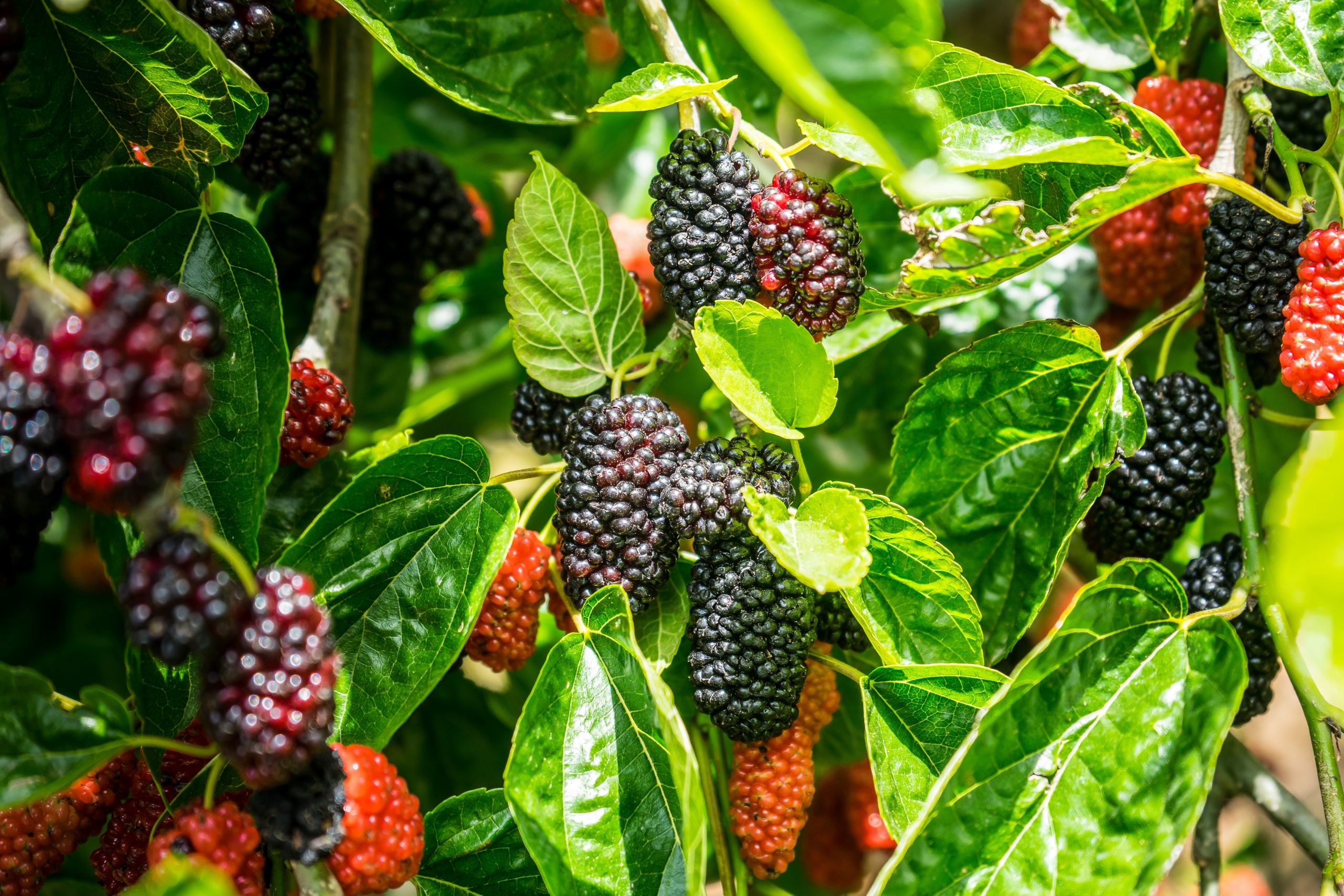
Learning how to grow mulberries can reward you with generous harvests of sweet, juicy fruit for many years to come.
For many of us, mulberries are wrapped up in childhood memories. Mine was a giant tree hanging over the back fence of an old Queenslander in Brisbane. Every afternoon on the way home from school, the local kids would gather beneath it, eating handful after handful of berries until our stomachs ached. We’d head home with purple-stained hands, faces and clothes, ready to face the inevitable grilling from Mum.
Ever since that time, I’ve wanted a mulberry tree of my own!
If you’ve refrained from planting one because you think they’re too big, think again. While mulberries can become magnificent shade trees, they’re also easy to keep compact with regular pruning. My tree never grows beyond 2–3 m high and wide, yet it produces more fruit than we can eat each season. There are even dwarf varieties that can be grown in containers.
Once you know how to grow mulberries, you’ll discover they’re among the toughest and lowest-maintenance fruit trees. They thrive in climates ranging from the tropics to cool temperate regions and tolerate most soil types, provided the drainage is good.
How to grow mulberries: 8 essential tips
Mulberries need little attention once established, but these simple steps will help your tree grow strongly and produce plenty of fruit.
- Plant bare-rooted trees during winter. Potted trees can be planted at any time of year.
- Choose a position in full sun or light afternoon shade.
- Improve the soil with compost before planting.
- Keep the soil consistently moist for the first few months while the tree establishes.
- Once established, mulberries are remarkably drought tolerant and usually need very little attention.
- If your soil is poor, apply compost and organic fertiliser in late winter as the buds begin to swell, then water it in well.
- During prolonged dry spells, particularly while fruit is developing or after pruning, give the tree a deep soak.
- Maintain a 5–7 cm layer of The Garden Family Sugar Cane Mulch beneath the canopy to help retain moisture in the soil. Keep the mulch clear of the trunk.
Following these fundamentals is the easiest way to grow mulberries that remain healthy, productive and manageable.
How to harvest mulberries
Knowing how to grow mulberries is only half the fun—the real reward comes when it’s time to harvest.
Mulberries fruit from late winter to early spring in tropical and subtropical regions, and from spring into early summer in cooler climates.
The fruit must be picked when fully ripe for the best flavour, as it won’t continue ripening once removed from the tree. Ripe berries will detach easily from the stem. That’s your cue to harvest!
For larger harvests, spread a tarp or sheet beneath the tree and gently shake the branches. The ripe fruit will fall while the unripe berries remain attached.
Fresh mulberries are delicious, but they’re also perfect for freezing, baking, smoothies and homemade jam—just in time to create thoughtful Christmas gifts for friends and family.
How to grow mulberries and keep trees compact
The secret to a productive, easy-to-manage mulberry tree is regular pruning. Fruit forms mainly on the previous season’s growth, so timing your pruning is important.
In the first year, cut young trees back to around knee height to encourage low branching. Immediately after each harvest, cut back the fruiting branches, leaving one or two buds to reshoot. New shoots will grow through summer, producing long, arching canes.These canes will carry the following season’s crop, keeping the fruit within easy reach.
If you need to reduce the size of an older tree, do so gradually over several seasons. Mulberries can bleed sap from large pruning wounds, so avoid removing large branches unnecessarily and use clean, sharp tools.
With this approach, you can grow mulberries without allowing the tree to take over your garden.
Best mulberry varieties to grow
Choosing the right variety is an important part of learning how to grow mulberries successfully:
- ‘Black English’ – Ideal for cooler climates, with large, sweet fruit.
- ‘Hicks Fancy’ – Produces smaller fruit but offers an extended harvest period.
- ‘Red Shahtoot’ – A compact tree with long, honey-sweet fruit.
- ‘White Shahtoot’ – Produces delicious white fruit that won’t stain little fingers or clothing.
How to grow mulberries in containers
Don’t have room for a full-sized tree? Dwarf mulberries are well suited to growing in pots.
Choose a container at least 60 cm wide and fill it with a premium potting mix. Position the pot in full sun, water regularly and feed the tree each spring with a controlled-release fertiliser. Light pruning after harvest will keep it compact and productive for many years.
As the potting mix settles over time, top-dress it with The Garden Family Pot Revival concentrated potting mix booster, keeping it clear of the base of the trunk. It helps restore moisture retention and replenish nutrients in tired potting mix, giving your mulberry a welcome boost without the hassle of repotting.
With plenty of sunlight, consistent watering and regular pruning, almost anyone can learn how to grow mulberries—even in a small garden.



